


Today, I'd like to introduce you to a rich cultural and heritage aspect of the region. Churches are the heart and soul of every town and village in the Ardennes Valley. Located at the center of these communities , most stand proudly and are visible from afar thanks to their imposing architecture . Some have survived the centuries without ever losing their splendor, bearing witness to the region's turbulent history, while others have been rebuilt or renovated over time, adapting to the changing times and the needs of the inhabitants.
They often house unexpected treasures : colorful stained-glass windows, majestic bell towers, remarkable sculptures, or surprising anecdotes. In this article, I invite you on a journey through these iconic monuments to better understand their role , their evolution , and their importance in the Ardennes heritage.
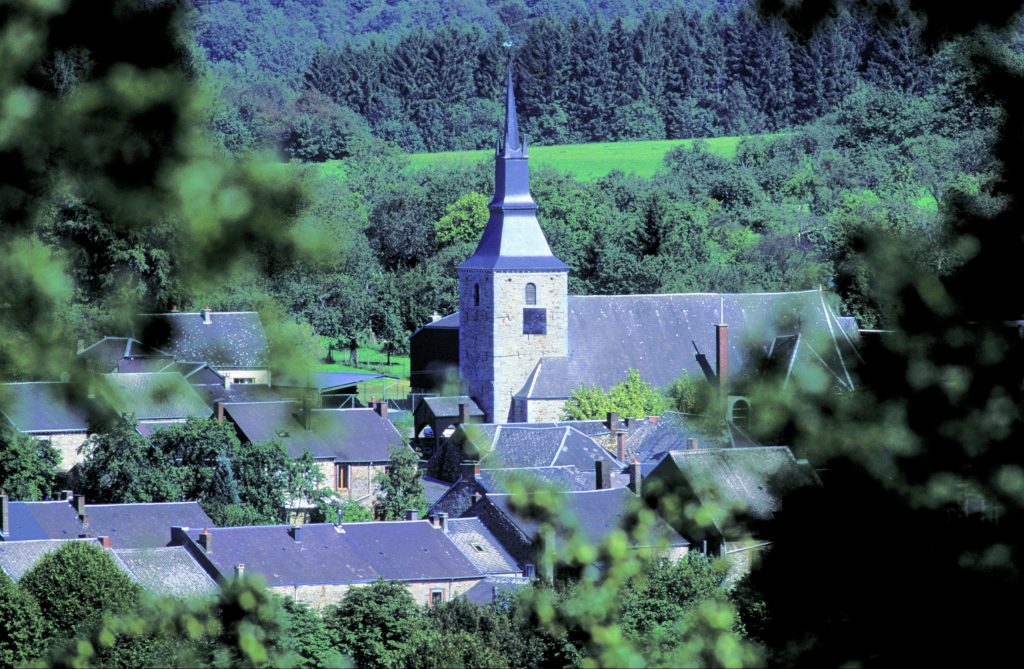
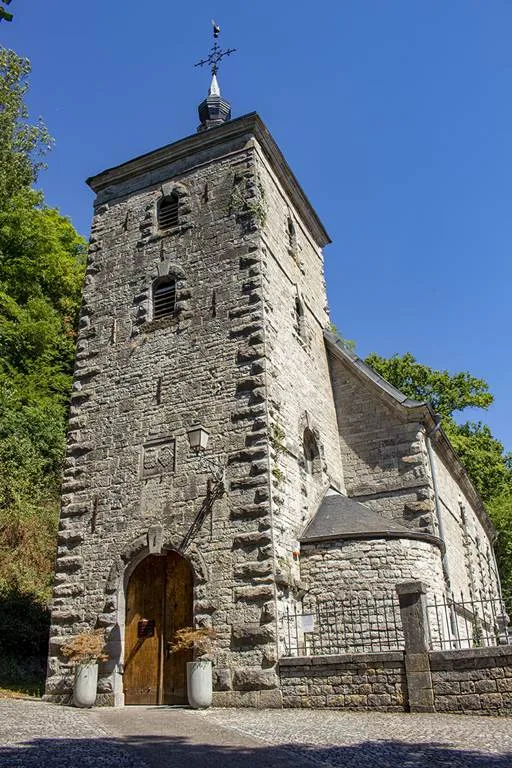
Saint-Lambert Church – Hargnies
The church of Saint-Lambert , located in the center of the village of Hargnies , is built of arkose rubble from Haybes and has a Latin cross plan . From the Middle Ages, it was under the jurisdiction of the abbot of Laval-Dieu, a right dating back to 1199.
This church also played a defensive role during the conflicts of the 16th and 17th centuries, notably during the wars between Charles V and Francis I , and later between France and Spain . In 1640, it was burned down by French troops, leading to its reconstruction in the mid-17th century, with an interior renovated in the 19th century.
The church is not open permanently for security reasons, but it is possible to organize a free guided tour by reservation with the town hall, in collaboration with the Hargnies Heritage Association.
Church of Saint Peter and Saint Paul – Haybes
The Church of Saint Peter and Saint Paul in Haybes , located north of the village near the Meuse River, was rebuilt after the destruction of the old church in August 1914. The current building, inaugurated in 1927, was designed by the architect Lemasson and built by Gustave Despas . Constructed of Haybes arkose rubble according to a Latin cross plan , it features limestone quoins, cornices, and window openings. Two statues of Saint Peter and Saint Paul , likely from the previous church, are also present. The church is only open to the public during religious services.
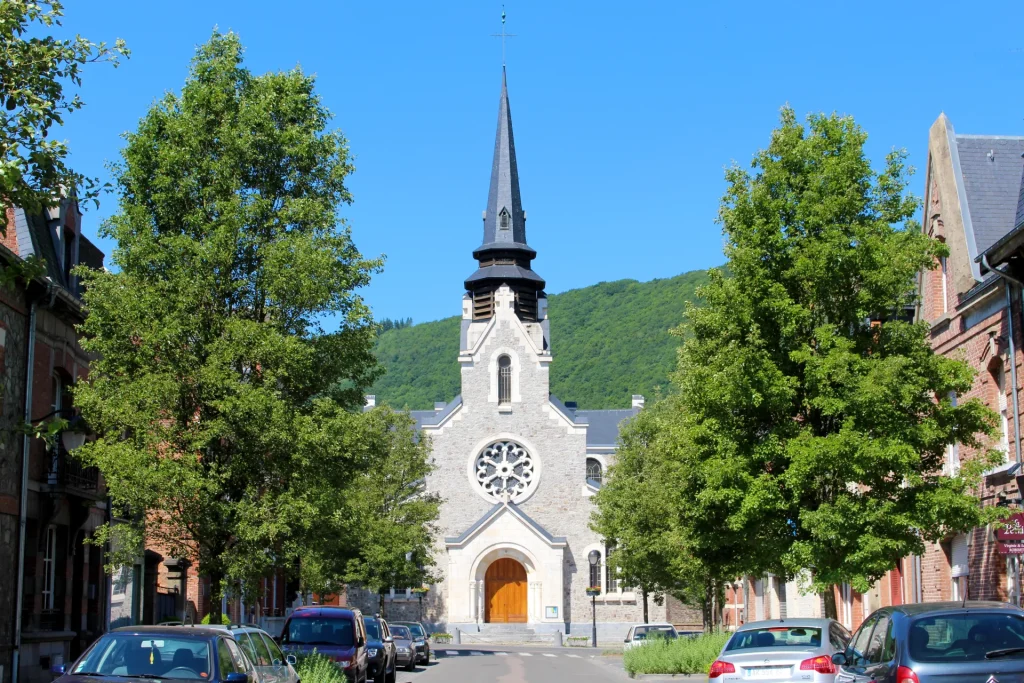

Former Recollect Church – Givet
This former 17th -century church is now used as a function hall . Therefore, the building is only visible from the outside.
A little anecdote: It was in this old church that Etienne Nicolas Méhul , born in Givet in 1763, played his first musical notes with the old organist of the church.
Saint John the Baptist Church of Hierges
A jewel of the Mosan Renaissance , the Church of Saint John the Baptist succeeded an earlier chapel. The current church was built in 1579 by the lords of Hierges, Gilles de Berlaymont and his wife, Lamberte de Croy . It was modeled after the churches of Foisches and Charlemont. One can also admire its beautiful portal, whose coat of arms was defaced during the French Revolution and bears a dedication plaque with the inscription: "Sir de Berlaymont and Lady Lamberte de Croy had this church built in honor of God and Saint John the Baptist in 1579." Inside, the church boasts remarkable furnishings dating from the late Middle Ages to the 18th century.

Dominican Church – Revin
Built in the early 18th century, the church is distinguished by its red brick façade and its style inspired by the Flemish architecture of that period. After the departure of the Dominicans in 1792 , it became the parish church , the old cemetery church having been abandoned due to its remote location and poor condition. A fire in 1886 destroyed the roof and the bell tower, but the interior artworks were preserved. During restoration, a campanile was installed in place of the original bell tower. The church houses the statue of the monk Charles René Billuard and has been listed on the Supplementary Inventory of Historical Monuments since 1926. Inside, the pulpit and two carved oak confessionals are also protected.
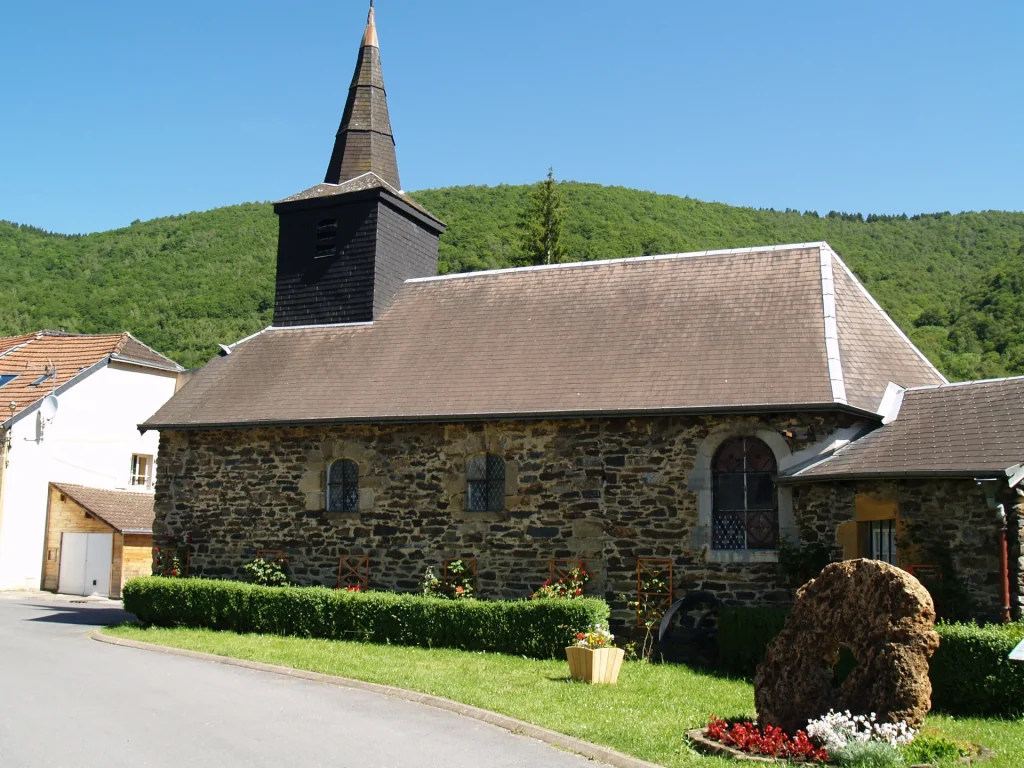
Saint-Pierre d'Anchamps Church
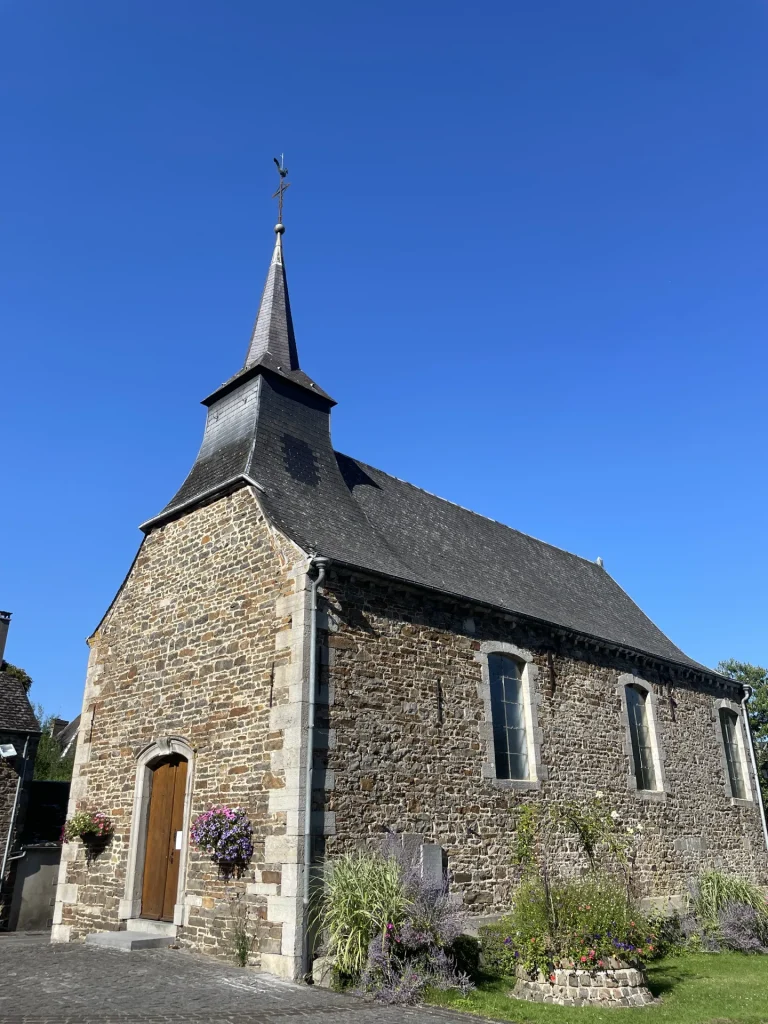
Located east of the village of Anchamps, the Church of Saint Peter , built of local stone , has an elongated plan with a nave and chancel forming a single vessel ending in a three-sided apse. The square bell tower stands to the west, at the ridge of the nave. The walls are made of schist rubble, while the window and door frames of the chancel and the portal are made of blue stone from Givet. The nave probably dates back to the 17th century, the portal and chancel having been rebuilt in 1766, according to the date inscribed on the keystone. A restoration also took place in 1825, though the specific area involved is not recorded. The church is only visible from the outside.
Notre-Dame Church – Givet
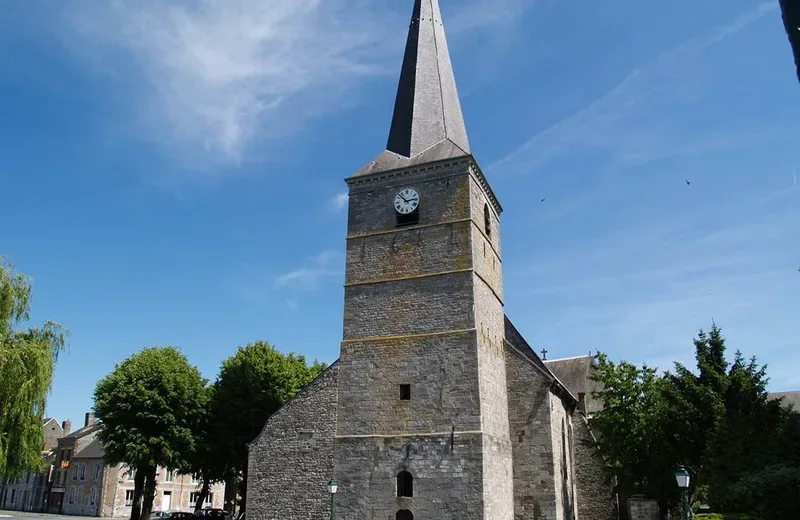
On the right bank of Givet , the Notre-Dame church is located in the Notre-Dame district.
Heavily damaged after the bombardment of 1675 by the troops of Marshal de Créquy, it was rebuilt in 1686. As a result, the bell tower now overlooks the Master Altar , a rather exceptional case. Vauban incorporated it into his overall plan for fortifications and urban development, which aimed to unite the two banks of the Meuse into a single fortified city.
This church houses a painting of “The Crucifixion of the Lord” by Rubens or Van Dyck.
Furthermore, the Notre-Dame church is located in Place Vauban , highlighting the importance of the military engineer in the development of this area.
Saint-Hilaire Church – Givet
Located on Place Carnot , in the heart of the city, the Rue de la Fausse Porte is unique in that it passes under the choir of the church through a beautiful stone vault . It was destroyed by Marshal de Créquy in 1675 and rebuilt under the direction of Vauban between 1682 and 1702.
It is possible that you are not familiar with the passage in “ Letter V: Givet” from Victor Hugo ’s Voyage Volume I dating from 1838 , in which he mocks the bell tower of the Saint-Hilaire church :
"The brave architect took a square priest's or lawyer's cap. On this square cap, he built an upside-down salad bowl; on the bottom of this salad bowl, which had become a platform, he placed a sugar bowl, on the sugar bowl, a bottle, on the bottle, a sun fitted into the neck by the lower vertical ray; and finally, on the sun, a rooster skewered in the upper vertical ray. Assuming that he took a day to find each of these ideas, he will have rested on the seventh day.
This artist must have been Flemish"
Saint-Georges Church – Fumay
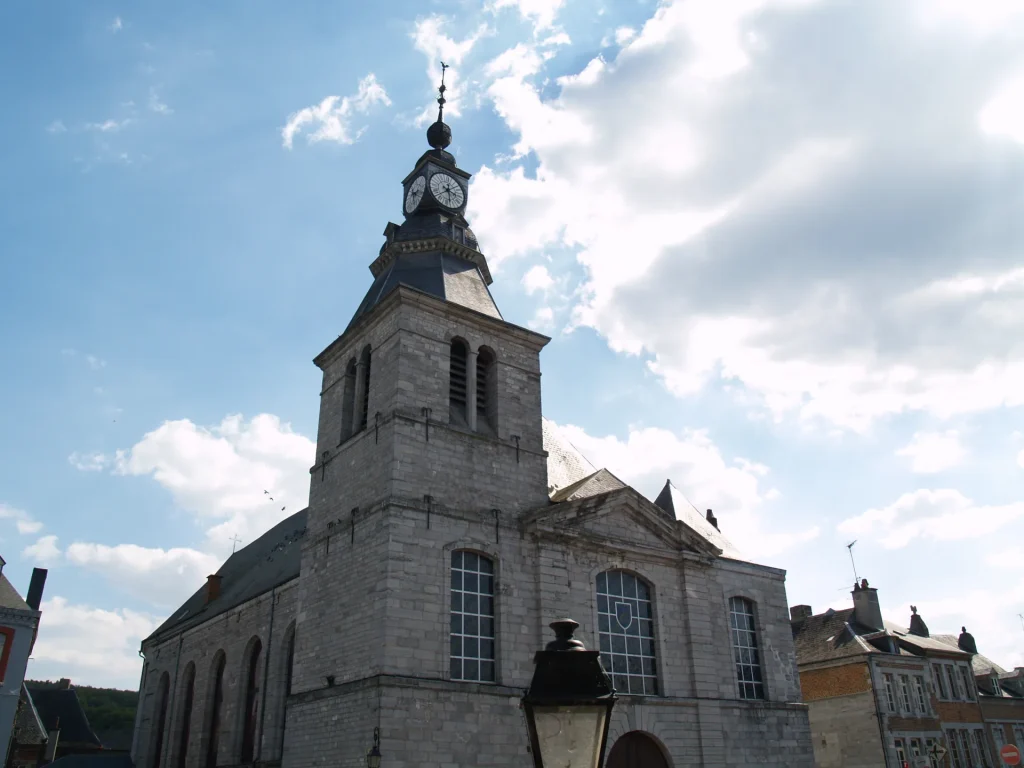
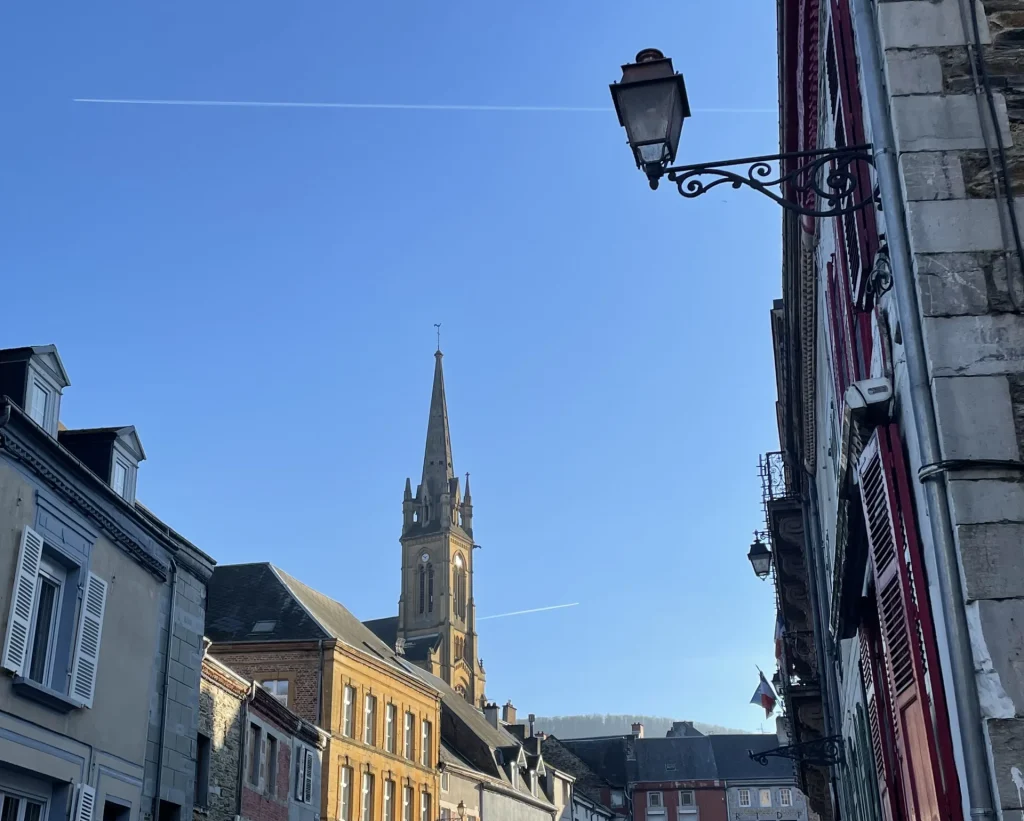
The church, dating from the 19th century, more precisely from 1876 , dominates the town of Fumay. Due to its size, the building seems to tower over the town below.
It is built entirely of dressed limestone from Dom-le-Mesnil , and the polygonal spire of the bell tower, flanked by four pinnacles, is made of Jaumont stone. Inside, one can admire magnificent stained-glass windows donated by the various confraternities of Fumay. Please note that the church is only open to the public during religious services.
Saint-Lambert Church – Montigny-sur-Meuse
Listed as a historical monument , this church, dating from 1765 , is undoubtedly the most famous in the valley . Its stucco decoration and the profusion of decorative motifs lend it a particular luxury . A vestige of a Gothic-style oratory , it holds many secrets within.
Thus, these churches are much more than just religious buildings. They bear witness to a rich and eventful history , are places of worship , symbols of pride for their inhabitants, and also true works of art in their own right. They deserve your full attention.
Let yourself be surprised by the riches these buildings contain. Share your discoveries with us!
Themes